

An accessibility tool that finds issues, proposes fixes as real code diffs, then reruns the checks to prove which fixes worked.
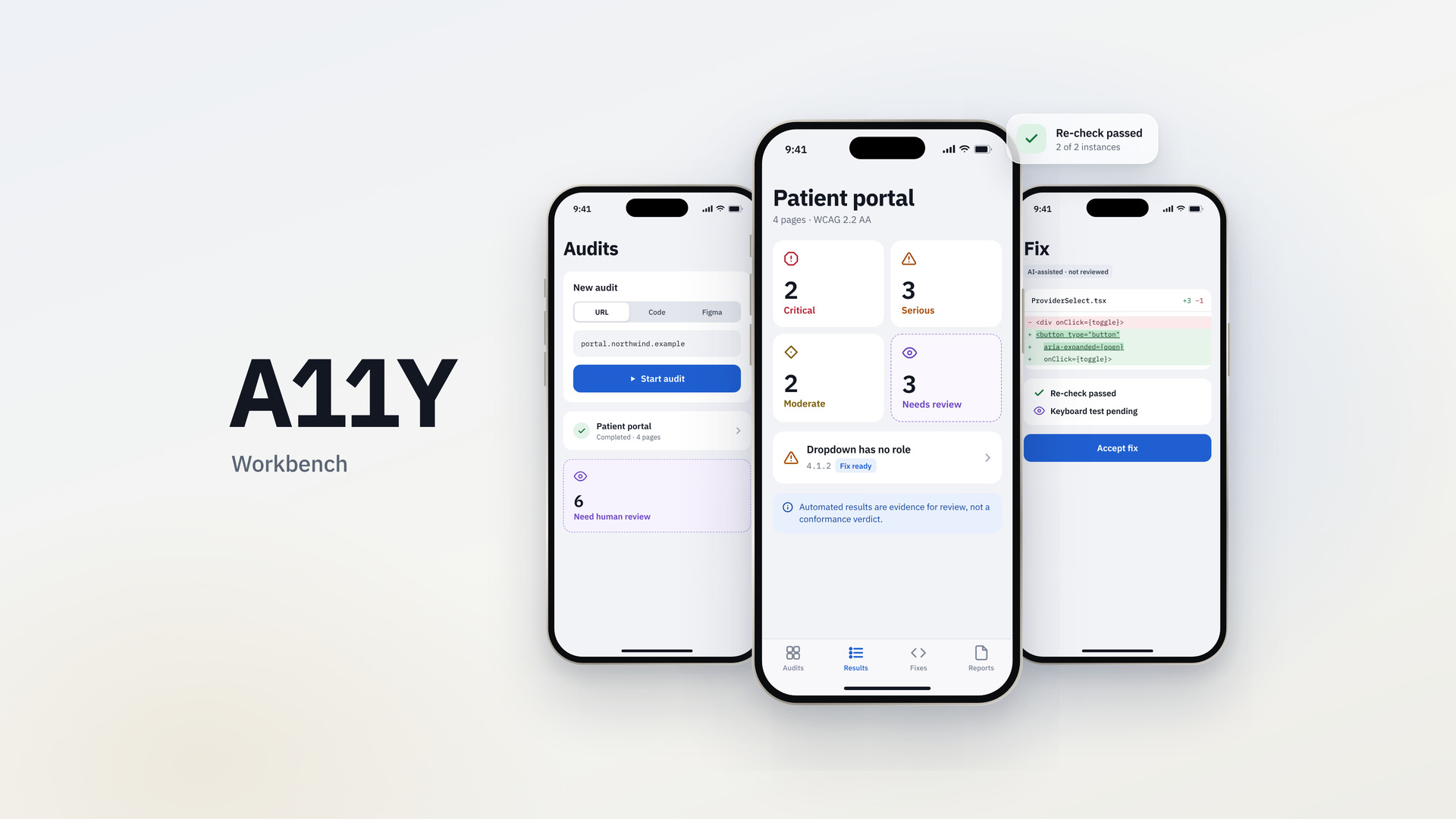
A11y audits a web page, pasted source code (HTML, JSX, TSX, CSS) or a Figma design against WCAG 2.2 AA, 2.1 AA, 2.0 AA or an AODA profile. Each finding carries its evidence, its WCAG criterion and its source line. Fixes are reviewed one at a time, combined into a patch and verified by a second scan.
Problem
Most accessibility tools stop at a list of problems. Teams still have to work out the fix, apply it, and check whether it worked or broke something else.
Users
Me first, as a designer doing accessibility work. Later, accessibility professionals and teams working to AODA in Ontario and WCAG elsewhere.
Intended outcome
Find it, fix it, prove it: a tool where no fix counts until a rescan confirms it.
My role
Product owner and designer. I wrote the product brief, co-built the code with Claude Code, reviewed it in VS Code and hand-tested it
Status
Working locally (v0.1.0). Not public yet: licensing, policy and documentation checks come first.
The challenge
Automated checks reach only part of WCAG, and a "correct" fix can still break something else. A useful tool has to be honest about both, without becoming another list of warnings.
The brief I wrote framed the product in three words: find it, fix it, prove it. Every design decision follows from making those three steps honest.
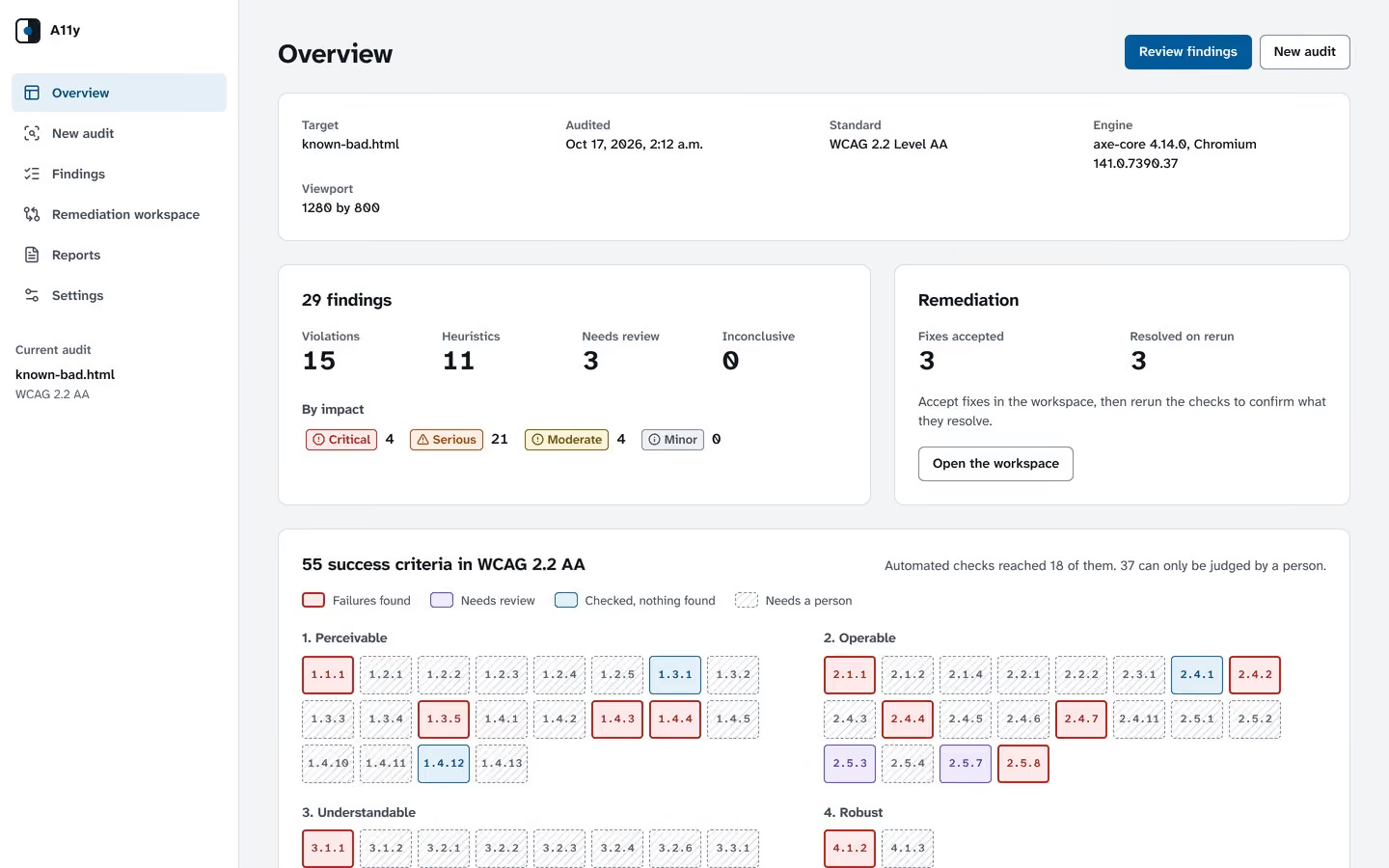
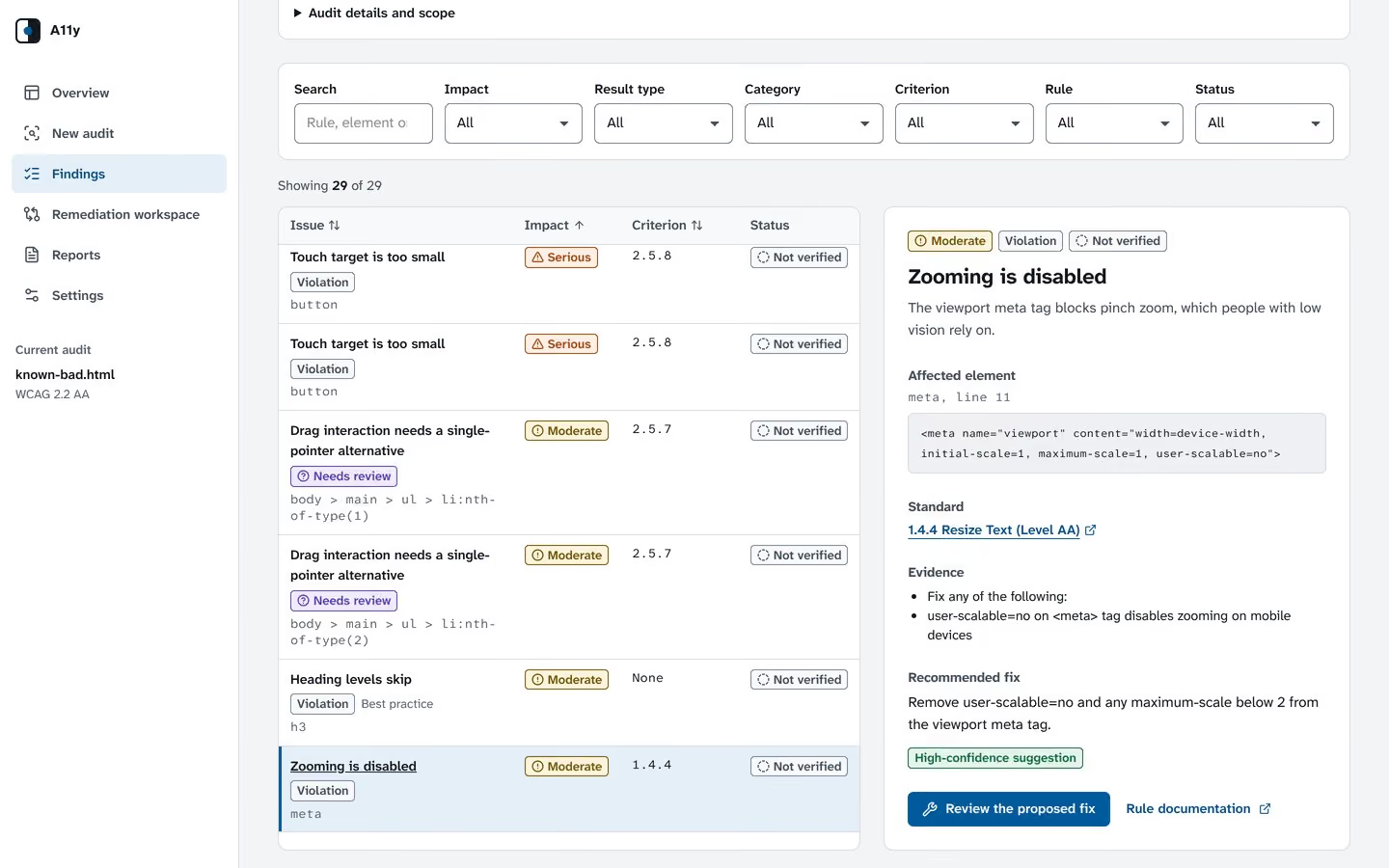
Honest findings. Results are split into four kinds, kept visibly apart: violation, heuristic, needs review and inconclusive. When a background can't be resolved (image, gradient, overlap, translucent layers), contrast is marked inconclusive and no ratio is shown. Ratios are truncated, never rounded, so 4.497 can never read as 4.50.
Show what automation cannot reach. The Overview maps all 55 WCAG 2.2 AA criteria. On the bundled test page, automated checks reached 18 of them, and the other 37 are shown as needing a person.
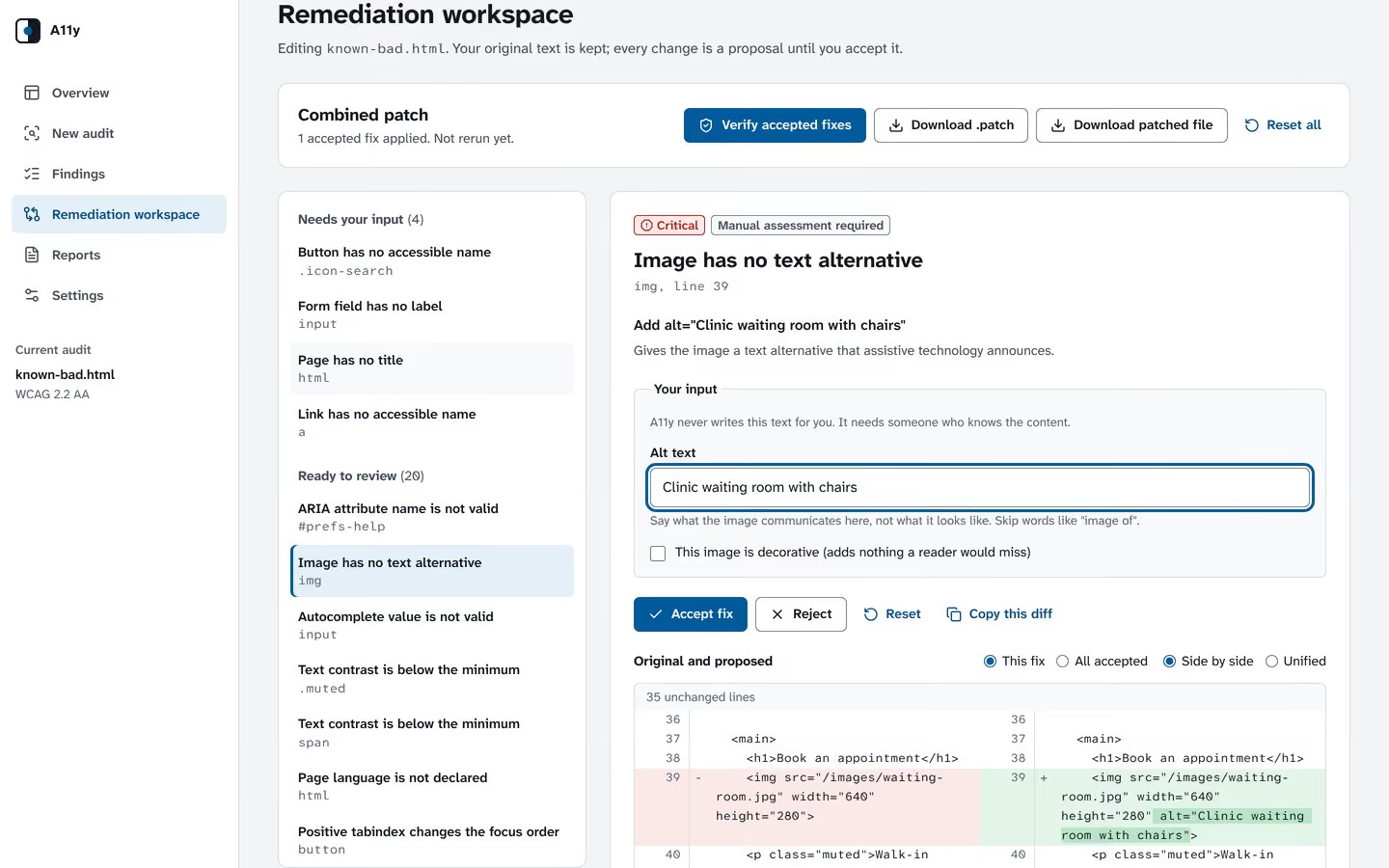
Three levels of fix confidence. Each fix is labelled high-confidence, review recommended or manual assessment required. For anything that carries meaning (alt text, names, labels, page titles), the tool never writes the words. It asks the person, and only then produces the edit.
Explain the trade-off, not just the number. Contrast fixes keep the hue and move lightness by the smallest step that passes. The tool shows the before and after ratios on a scale, and warns when a CSS rule may style other elements too.
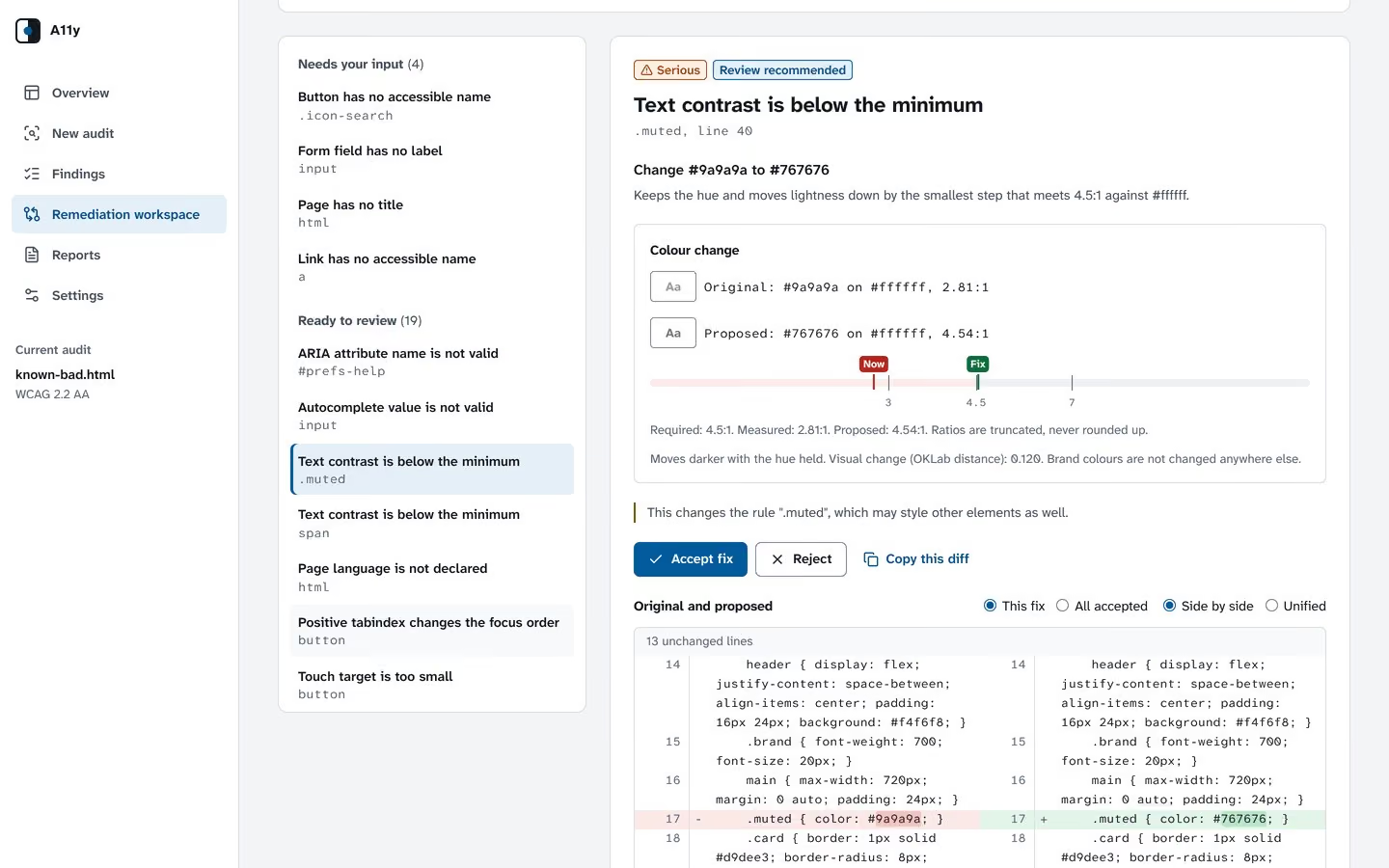
Built for low-vision readers. The interface uses Atkinson Hyperlegible Next and Mono from the Braille Institute, with light and dark themes and a layout that works down to 360 px.
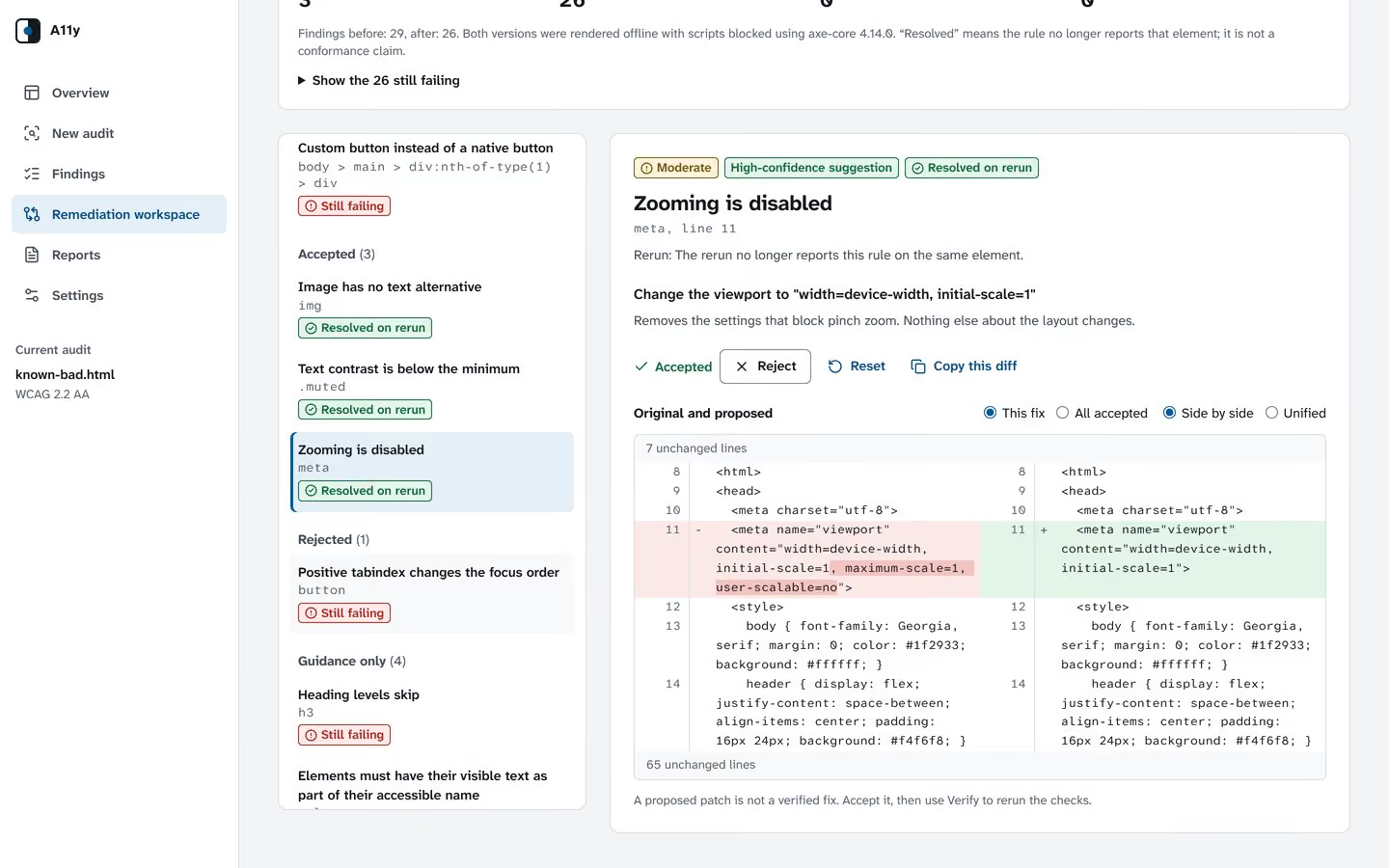
The product promise became the architecture. Verification is a separate step that rescans, so the interface can never show a fix as resolved on trust.
Findings point at exact characters. Before rendering, every start tag is stamped with its source position as its first attribute, so the position survives the engine's shortened snippets. Fixes edit only those characters, and a reviewer sees each change as a side-by-side or unified diff.
Code is read, never run. Submitted HTML loads in a sandbox whose content security policy blocks every script. JSX is turned into static HTML through the TypeScript compiler, never executed, and the audit says so on every screen.
The rerun reports what a patch broke. On the bundled clinic page, correcting a misspelled aria-labeledby exposes a new aria-prohibited-attr failure. Swapping a div role="button" for a native button reveals that the page's button:focus { outline: none } now hides focus. Verification catches the side effects of a "correct" fix.
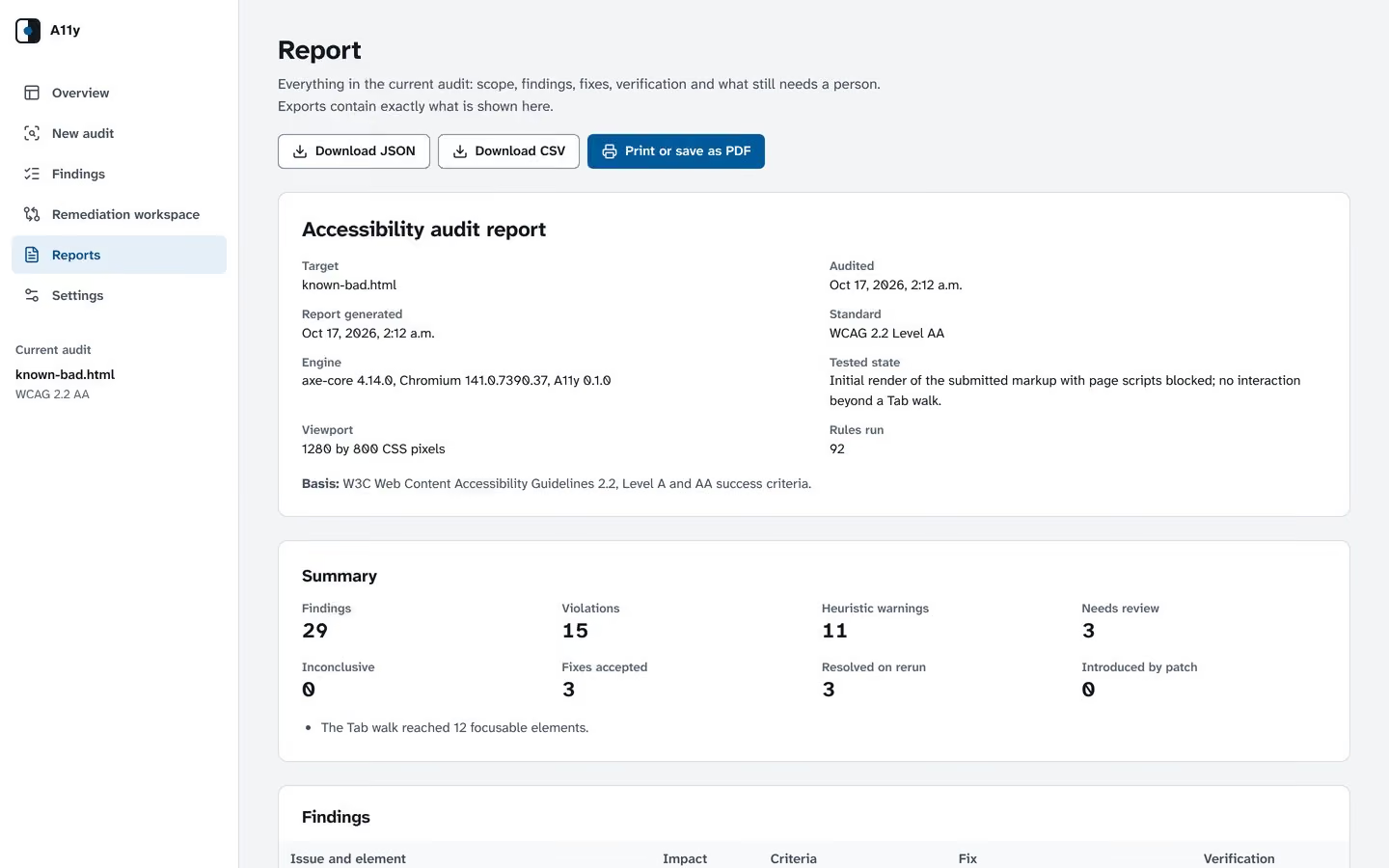
Reports never overclaim. Every export states the standard, scope, engine version and limits, and includes a manual-review checklist for every criterion in the profile. Exports cover a .patch file that applies with git apply, the patched file, JSON, CSV and print to PDF.
Note on the one integration failure. It expects a 401 page to be reported as "access denied". The Chromium in my workspace (141) throws an error on an empty 401 response instead of returning it, so the tool reported "unreachable". The build notes record this suite passing on the expected browser. It is still worth handling, since a scanner can meet more than one browser version.
Security as a design constraint. Each URL scan runs its own forward proxy. Every hop, including redirects, images and websockets, is resolved, refused if any address is private, and then connected to the exact address that was checked. This closes the DNS-rebinding gap that a check-then-fetch approach leaves open. Tests confirm that an internal server receives zero requests.
Git and delivery. The repository is public on GitHub, and I push through GitHub Desktop. History shows 16 conventional commits from the build session and my rename commit across 18 files. There is no CI pipeline, and the app is not deployed: it needs a long-running Node server with Chromium, and I am completing licensing, policy and documentation checks before it goes public.
A11y v0.1.0 runs end to end on my machine: scan, review, fix, verify and export. I use it for my own accessibility work.
.patch exports.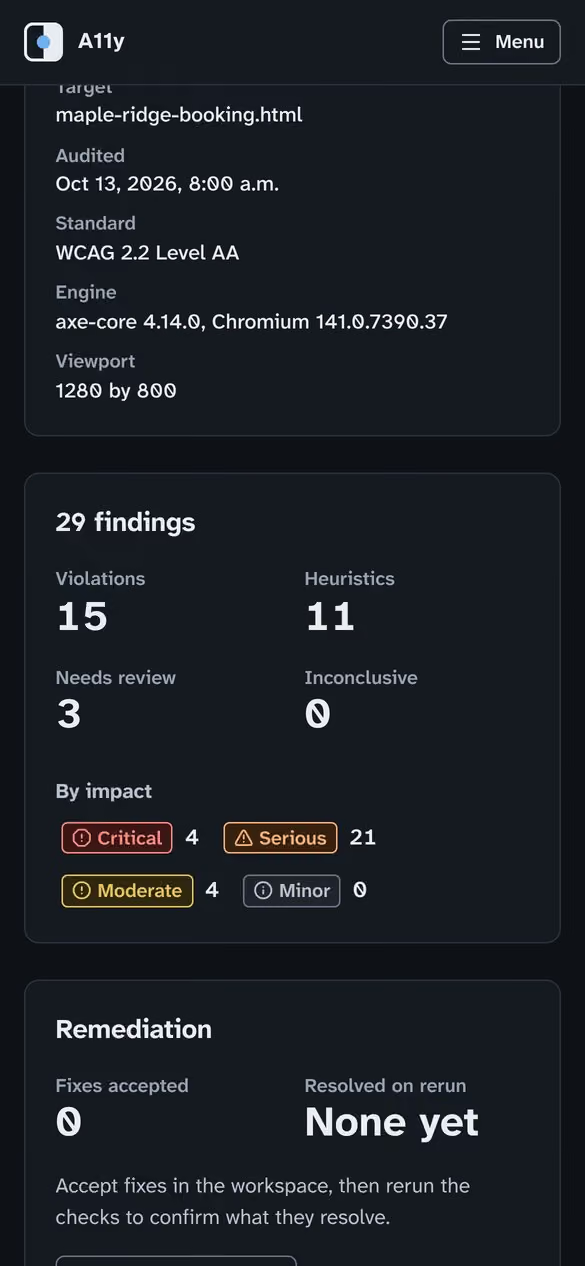
Still open
docs/github-integration.md, not code yet.Product design
A brief built on find, fix, prove; fix confidence as a product concept; limits stated in the product itself
UX/UI and accessibility
Four finding kinds kept apart; the person writes anything that carries meaning; a criteria map showing what automation cannot reach; low-vision typeface
Technical implementation
Rescan-based verification, source-line tracing, a script-free sandbox, Figma JSON analysis
Code review and quality
Reviewed AI-written code in VS Code; the app audits itself and passes in both themes
Testing and delivery
Unit, integration and end-to-end suites; Git through GitHub Desktop
Design
Atkinson Hyperlegible Next and Mono, Lucide icons, light and dark themes. [NEEDS CONFIRMATION: Figma or other design files]
Development
Next.js 16 App Router, React 19, strict TypeScript 6, Tailwind 4, Zod 4, Playwright-driven Chromium, axe-core 4.14, diff
Testing
Vitest (unit and integration), Playwright (end to end), axe-core self-audit, ESLint
Version control and deployment
Git, GitHub, GitHub Desktop. Not deployed; no CI pipeline yet
AI-assisted
Claude Code for shared code authorship; an optional AI explanation feature, off by default, that treats finding data as untrusted input
Live product
Not public yet
GitHub repository
github.com/dannycyph3r/A11y-workbench


